Brand & presence
Your digital presence is part of the customer experience
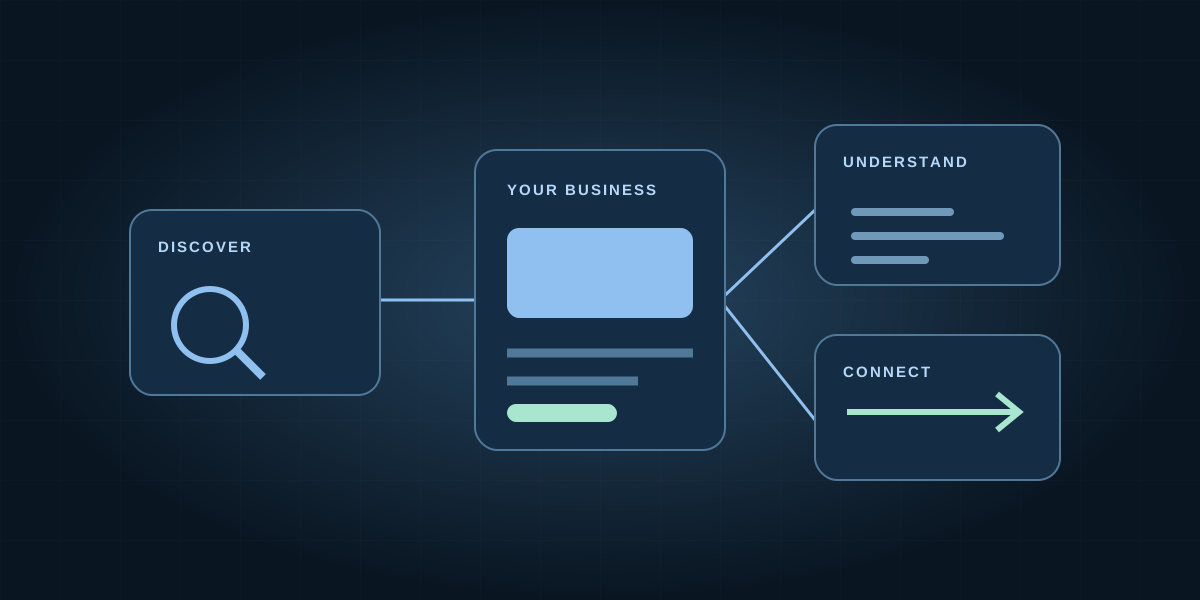
A customer can discover you in one place, evaluate you in another and contact you somewhere else. The gaps between those moments often matter more than another channel.
By Matteo Gelsomini ·
- Customer confidence
- Consistent information
- Useful enquiries
Customers experience a journey, not a channel
A business owner may see a website, social profile, directory listing and proposal template as separate pieces of marketing. A prospective customer experiences them as evidence about the same business. They notice whether the offer stays consistent, whether the work looks relevant and whether it feels easy to get a straight answer.
Consider an illustrative local service business. A customer finds a convincing project on social media, follows the website link and discovers a vague list of services with no indication of the area covered. They may still make contact, but the website has created a question that the earlier impression had already seemed to answer. The problem is the connection between the two experiences.
Visibility and credibility solve different problems
Visibility gives someone the opportunity to consider you. Credibility gives them a reason to continue. A business can have healthy traffic and still leave visitors unsure whether it understands their situation. Equally, a clear and convincing website cannot help people who never encounter it. These are different investment decisions, even when they eventually belong in one plan.
Before increasing acquisition spend, it is useful to understand what an interested visitor can actually establish. Can they recognise their problem in your offer? Can they see a relevant example? Can they tell what happens after an enquiry? A new campaign may amplify an unclear experience as efficiently as it amplifies a strong one.
Consistency makes a business easier to evaluate
Consistency includes the basics people rely on: the service name, the audience, the current offer and the way to reach you. It also includes tone. A premium, careful service described with restrained language on the website can feel less credible if the next touchpoint promises instant results without qualification.
This does not mean every channel must look identical. A short social post and a detailed service page have different jobs. The useful standard is that they support the same expectation. A customer should not need to reconcile conflicting claims or work out which version of the business is current.
The enquiry is only the beginning of conversion
An enquiry form is a handover from marketing to operations. If the form asks for information nobody uses, it creates unnecessary effort. If it asks for too little, the customer may have to repeat themselves through several emails. If no one owns the response, the cleanest interface in the world will still lead to a poor experience.
For a business with limited capacity, better qualification can be more valuable than more messages. Useful context might be the type of problem, the service location or an important deadline. The right balance depends on the decision being made and the information needed to continue the conversation. It should be agreed with the person handling the enquiries.
Choose the next improvement around a real gap
A complete redesign is not always the next useful investment. If customers consistently misunderstand a service, the offer and supporting content may need attention. If they understand it but cannot complete an enquiry on their phone, the interaction deserves attention. If good enquiries wait unanswered, an operational change may matter most.
The strongest brief connects an observed difficulty to a business consequence. 'People ask whether we cover their suburb' gives a specialist more to investigate than 'we need a modern website'. It also creates a clearer way to assess whether a change has helped, while recognising that demand, seasonality and response quality can influence the result.
What a useful review should leave you with
A useful review should explain the main obstacles in the customer journey, the evidence behind them and a sensible order of work. It should distinguish changes you can evaluate now from assumptions that need customer feedback or measurement. A list of fashionable features is less useful than an explanation of which customer decision each improvement supports.
For an owner, the central question is whether the digital experience makes the business easier to understand and easier to deal with. That keeps attention on the whole relationship, including what happens after a visitor leaves the website.
Further reading
- Google Search Central: helpful, reliable content: Google's guidance on content written for a real audience and a clear purpose, rather than search rankings alone.