Business systems
What happens in a process review
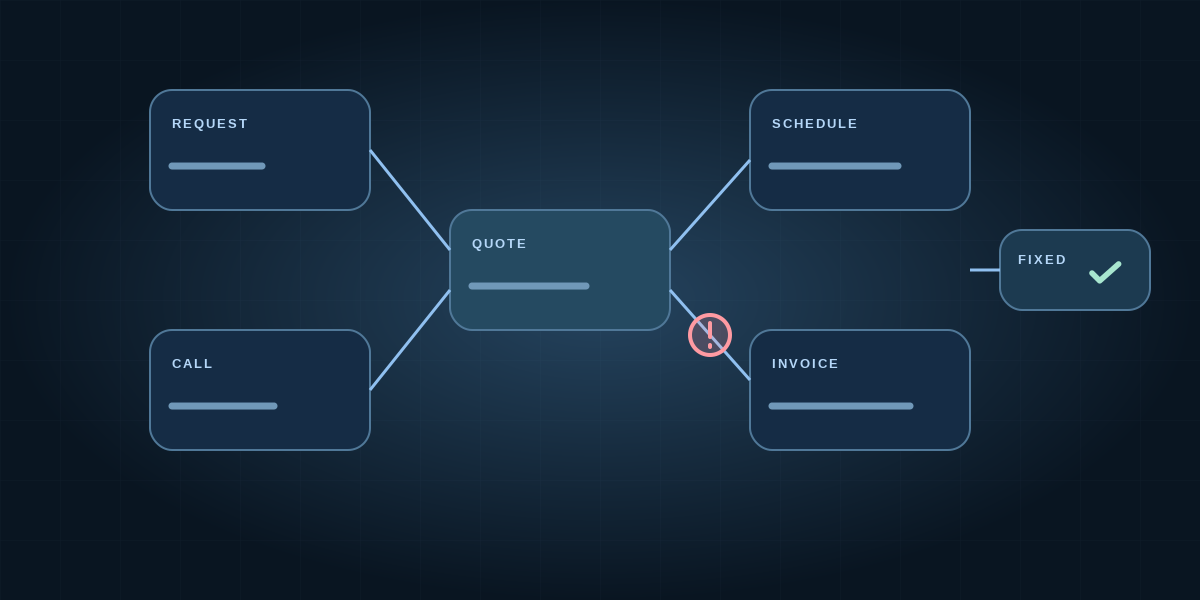
A process review is a short, fixed-price first step: one conversation about how the work moves through your business, a one-page map of the process and a fixed price for what to change. Sometimes the answer is not to build anything yet.
By Matteo Gelsomini ·
- Fixed price
- One-page map
- Honest scope
Why software projects start with a review
Most software projects that go wrong do so before the first line of code. The idea was clear in someone's head, the quote was based on that idea, and the process turned out to have exceptions, owners and tools nobody had mentioned. The build then absorbs the discovery, and the price and timeline move with it.
A process review puts that discovery first, in a small and fixed piece of work. It is short enough to be affordable and specific enough to produce a fixed price for the scope that follows.
What is included
On this site, the process review costs AUD 300, fixed. It includes three things.
- One conversation about how the work moves through your business today and where it gets stuck.
- A one-page map of the process.
- A fixed price for the agreed scope.
Before the conversation
A little preparation makes the conversation far more useful. None of it needs to be polished, and nothing needs to be written specially for the review: screenshots, a forwarded email chain or a copy of the spreadsheet in use are often more revealing than a tidy description.
- Two or three real, recent examples of the work going through the process, including one that went wrong.
- The tools involved: forms, inboxes, spreadsheets, CRM, accounting, portals.
- The people involved, and ideally one of the people who does the work every day.
- What you would like to be different, in plain words, such as "we lose track of follow-ups" or "invoicing takes two days".
During the conversation
The conversation follows a real example from start to finish: where it comes in, who touches it, what information moves between tools, where it waits and what happens when something is missing. The aim is to understand how the work actually runs, which is often different from how it is described.
Exceptions get as much attention as the normal path. Changed orders, missing documents, late payments and unusual customers are where most of the effort and most of the software cost hide. The conversation also identifies what already works and should be kept.
After the conversation
You receive a one-page map of the process: the stages, the people, the tools and the points where work gets stuck. It is written to be useful on its own, whether or not a project follows.
If there is a sensible next step, you also receive a fixed price for the agreed scope. That might be one of the operations portal packages, from AUD 3,000; an automation between the tools you already have; or a care plan for an existing system. The AUD 300 is credited in full against the project if you go ahead within 30 days.
An illustrative example
Consider a hypothetical service business that receives enquiries through its website and by phone. Enquiries are copied into a spreadsheet, quotes are written in a word processor, accepted quotes are emailed back and the work is scheduled in a shared calendar. Invoices are prepared at the end of the month from the calendar and the emails.
A review would follow two or three real enquiries through that chain. It might find that most delays happen between the accepted quote and the calendar, that two people keep separate versions of the spreadsheet and that invoices miss extra work agreed by phone. The map would show those points. The fixed price might then cover one intake and follow-up workflow, not a complete system, because that is where the time is lost. This is an example to show the shape of a review, not a client result.
What a review is not
- It is not a sales call. That is the free 30-minute introductory call, which decides whether a review is worthwhile.
- It is not a full specification. For a custom software build, the specification and design are approved before development starts, as part of the project.
- It is not a commitment to build. The fixed price is an offer, and the map remains useful if you decide not to proceed.
Sometimes the answer is not to build
A review can conclude that the process needs clarifying before software would help, that a standard product would do the job, or that the best first step is a small change to the tools already in use. That outcome is still worth having. It costs far less than discovering the same thing halfway through a build.
The guide to which tasks are worth automating uses some of the same questions, if you want to test a candidate yourself first.
How it fits the rest of a project
The review is the first of a few steps, each with a clear output. The review produces the map and the fixed price. If you go ahead, the specification and design are approved before the build starts, the work is tested on a staging copy before go-live, and the system then runs on a managed hosting plan. The Process & proposals page describes each step, and the article on what custom software costs explains how the prices fit together.
When a review is required
Every operations portal package starts with a process review, because its fixed quote depends on it. A care plan for a system someone else built also follows a review of that system, so its condition and risks are known before it is maintained.
Frequently asked questions
How long does the conversation take?
Long enough to follow one or two real examples from start to finish. The map and fixed price follow once the conversation is complete.
Can we use the map with another provider?
Yes. It is a description of your process, written for your business, and you can use it however you decide to proceed.
What if the scope changes after the fixed price?
The fixed price covers the agreed scope. Anything new is described and quoted as a change request before work starts, so the price never changes without your agreement.
How do we book one?
Start with the free 30-minute call, or answer a few questions in the plan finder to see whether a review is the right first step.