Infrastructure
Managed hosting for business software: what you are paying for
Shared web hosting, a cloud account you run yourself and managed hosting can all run the same application. They differ in who is responsible when an update, a backup or a full disk needs attention.
By Matteo Gelsomini ·
- Clear responsibility
- Tested backups
- Honest limits
The same application, three ways to run it
Business software needs somewhere to run: a server for the application, a database for the records and storage for files. Most businesses choose between three arrangements. They can cost similar amounts in a given month and still leave very different work for the business.
Shared web hosting
Built for websites. Many sites share one machine and a control panel, which keeps the price low. It suits a brochure site, but usually not an application with its own database, background jobs and sensitive records, because the environment and its limits are set by the host for everyone at once.
A cloud account you run yourself
Large cloud providers rent servers and databases by the hour. The business holds the account and controls everything, which is genuinely useful when it has someone to operate it. Without that person, updates, alerts, certificates and backups quietly become nobody's job.
Managed hosting
A provider runs the environment for the application and is responsible, in writing, for keeping it updated, monitored and backed up. The business pays a monthly fee instead of employing or contracting that work separately. It costs more than shared hosting and usually less than doing it properly in-house.
What the monthly fee should cover
"Managed" is used loosely, so the details matter. A useful plan says, in writing, what is done and how often. The plans on this site list the following, at three levels of capacity and support time.
- A dedicated application server and a managed database in Sydney, not a slot on a shared machine.
- Routine security patches and a monthly vulnerability review.
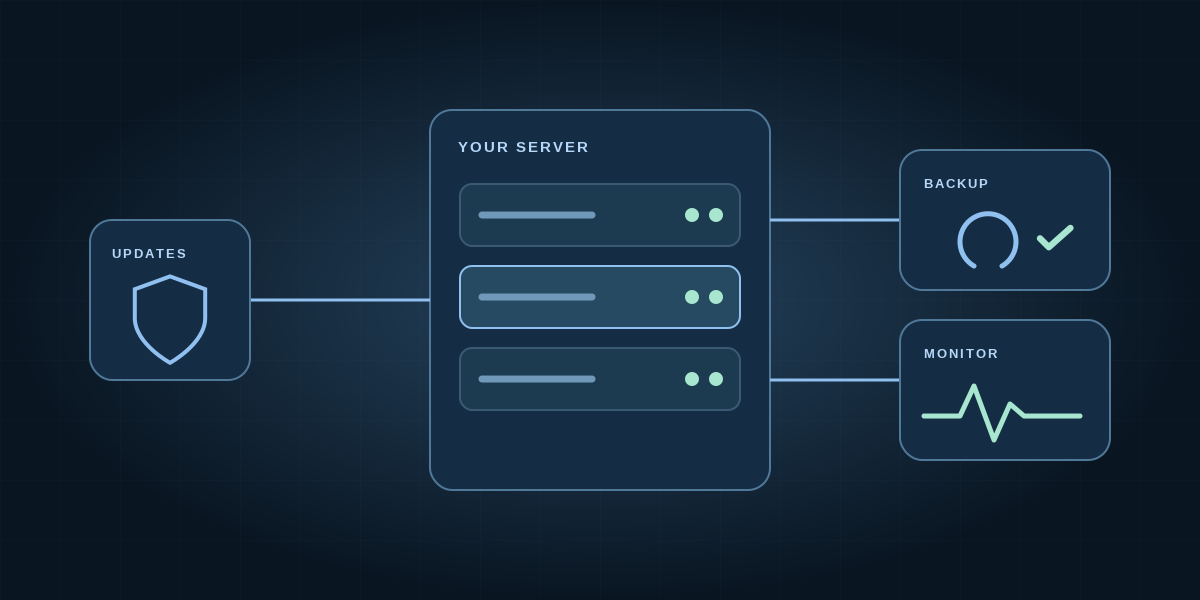
- Automated uptime and certificate checks around the clock, with alerts. That is monitoring, not a team watching screens overnight, and a plan should say so.
- Daily backups with encrypted secondary copies, kept for 7, 14 or 30 days, and a restore test quarterly or monthly.
- HTTPS certificates, DNS and renewal checks.
- Operational work in 15-minute units: one, two or three hours a month, with requests acknowledged within one business day.
- A regular service summary and an assisted export of your data.
Backups are a process, not a setting
Almost every host mentions backups, and the cybersecurity guide explains why recovery is a business continuity question. Fewer hosts can say when a backup was last restored, how long the restore took and whether the result was complete. A backup becomes evidence only when it has been recovered into a separate environment and checked.
Retention matters as well. Seven days of history is enough to recover from a failed update. It may not be enough to recover from a mistake that nobody noticed for three weeks. Choose retention by asking how far back the business might need to go, and how much work it could afford to re-enter.
Limits a good plan states openly
Every hosting arrangement has limits. The useful ones are written down, so the business can decide whether they are acceptable rather than discovering them during an incident. The plans on this site, for example, state that:
- the application runs on a single server and the database on a single node, without automatic failover;
- the server itself is not backed up, so application data must live in the database or file storage, which are;
- disk, database and storage sizes have stated limits, which can be raised with add-ons;
- monitoring is automated around the clock, with alerts, but it is not a staffed 24/7 response.
Releases are part of hosting
Most outages of business software are caused by changes, not by hardware. A new version, an updated dependency or a configuration change can break something that worked yesterday. Managed hosting should therefore include how changes reach production: tested first, released in a planned way, checked once live and reversible if something goes wrong.
Where the plan includes a separate testing environment, your team can try a change on realistic data before customers see it. The infrastructure page describes how environments, releases and rollbacks are run here.
Where the data lives
Hosting in Australia keeps records close to the people who use them. If the business holds personal information, where it is stored and who can access it can be relevant to its obligations under the Privacy Act. The Australian Privacy Principles, including APP 8 on overseas disclosure, are published by the OAIC. Whether and how they apply depends on the business, so it is worth confirming with your adviser.
Ask a hosting provider which services are used, in which region, and which other companies can access the data to provide them. A clear answer is a good sign in itself.
Matching the plan to the system
Capacity is rarely the hard choice. Most business systems start comfortably on a modest server and grow later. The more important differences are backup history, how often restores are tested, how much support time is included and whether there is a place to test changes before they go live.
On this site, Custom Core costs AUD 300 a month, Growth AUD 490 and Business AUD 890. Growth adds a shared testing environment where your team can try changes before release, and longer backup history. Business adds 30-day backups, monthly restore tests and requests handled first. The managed hosting page compares them line by line.
Questions to ask any hosting provider
- Who applies security updates, how often, and how are they verified?
- When was a backup last restored, and can you show the result?
- What happens at 2 a.m. when the site is down: an alert, a person, or both?
- What is not covered, and what does extra work cost?
- How do we get our data, and in what format, if we leave?
Frequently asked questions
Can managed hosting run software someone else built?
It depends on the system. Running software you did not build means first learning how it is deployed, configured and backed up, so it starts with a review. A care plan covers ongoing work on systems built by others.
Is a single server enough for a business system?
For many internal tools and portals, yes, provided backups are tested and the recovery time is acceptable to the business. Systems that cannot tolerate an outage of any length need redundancy, which costs considerably more and should be designed deliberately.
What happens to our data if we stop the service?
A clear plan provides a standard export of your data and hands over the credentials for accounts you own. The remaining copies, including backups, should then be deleted within a stated period.
Do we still need our own IT support?
Possibly, for devices, email and office systems. Managed hosting covers the environment your business software runs on, not the computers your team uses.
Further reading
- OAIC — Australian Privacy Principles: Including APP 8, which covers disclosing personal information to recipients outside Australia.